

The Tire Recycling Foundation Circle of Change Awards program is a national recognition program honoring organizations, teams, and individuals who are advancing tire recycling technologies, expanding end-use markets, and demonstrating leadership in sustainability and circular economy principles.
The Circle of Change Awards highlight the people and partnerships turning challenges into opportunities, building markets, driving innovation, and shaping a more sustainable future for end-of-life tire management across the United States.
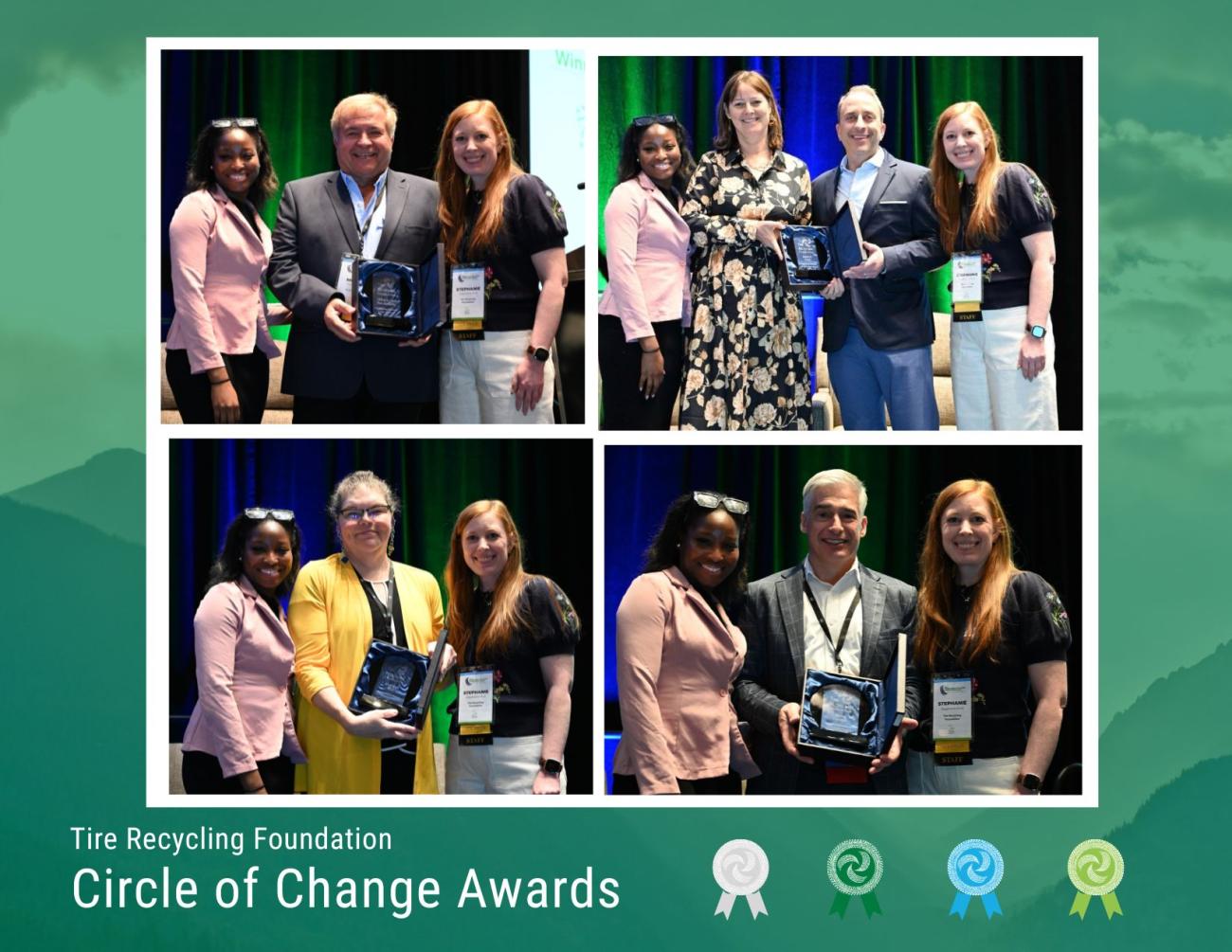
Finalists for the Inaugural TRF Circle of Change Awards
The Tire Recycling Foundation (TRF) is pleased to announce the finalists for its inaugural Circle of Change Awards. These finalists were selected by an independent panel of expert judges based on their achievements in advancing sustainable tire recycling, circular solutions, and high-value end-use markets.
Innovation in End-Use Technology Award
- Bolton & Menk
- LHB Engineer and St. Paul Port Authority
- Liberty Tire Recycling
Circular Economy Trailblazer Recognition, State Leadership in Tire Market Innovation
- Colorado Waste Tire Program – Colorado Department of Public Health and Environment (CDPHE)
- North Carolina Legislature
Market Development Excellence Award
- Alabama Department of Conservation and Natural Resources (ADCNR), Alabama State Parks, and the Alabama Department of Environmental Management (ADEM)
- Michigan Department of Environment, Great Lakes, and Energy (EGLE) & Partners
Value Chain Collaboration Award
• Phibro rCB, LLC
• Bolder Industries & Pirelli Tire LLC
Innovation in End-Use Technology Award
This category recognizes projects that have found new and inventive applications for recycled tire materials, demonstrating that end-of-life tires are a versatile resource for solving real infrastructure and environmental challenges.
Bolton & Menk
Bolton & Menk designed an innovative stormwater best management practice system for the City of Woodbury Public Works and Parks Maintenance Facility expansion that integrates porous asphalt with underground tire-derived aggregate storage and infiltration basins. The project demonstrates how TDA can serve as a high-performing green-infrastructure component beneath functional parking areas.
Transforming End-of-Life Tires into Sustainable Engineering Solutions
The City of Woodbury needed to meet updated watershed-district stormwater requirements while supporting facility expansion, managing runoff from large impervious areas, and advancing its sustainability goals as a Minnesota GreenStep City.
The design team combined infiltration basins, wet sedimentation basins, a hydrodynamic separator, porous asphalt, and underground TDA infiltration zones. TDA was selected for its high void space, permeability, and lightweight structure, allowing runoff to be stored and infiltrated beneath the parking area while also reducing material costs compared with conventional stone aggregate.
The Impact
- Approximately 210,000 recycled tires were repurposed into two underground infiltration basins.
- The TDA subbase reduced aggregate costs by about 60% compared with traditional stone and remains cost-effective over the long term.
- The system reduces runoff volume, lowers peak flows, filters pollutants, and supports groundwater recharge.
- The project reportedly repurposed roughly three years’ worth of the City of Woodbury’s discarded tires.
LHB Engineering & St. Paul Port Authority
LHB Engineering and the St. Paul Port Authority redeveloped the former Old Midway Stadium brownfield site using a large underground tire-derived aggregate (TDA) stormwater retention and infiltration system. The project paired brownfield remediation with resilient stormwater design so the property could be redeveloped without increasing contamination risks to nearby waters.
Protecting the Mississippi River with Recycled Tires
Redeveloping the site meant managing higher stormwater volumes on a brownfield property in a way that prevented water from moving through contaminated soils and carrying pollutants toward the Mississippi River. Redevelopment would increase impervious cover from 48% to 76%, so the project needed a stormwater system that could safely manage higher runoff volumes without allowing infiltration through contaminated soils.
LHB engineered a stormwater system using about 30,000 cubic yards of TDA to collect, store, treat, and infiltrate runoff in a designated uncontaminated area. The design included geotextile and sand layers to protect long-term performance and an overflow connection to the municipal storm sewer for extreme events beyond system capacity.
The Impact
- The TDA system uses approximately 30,000 cubic yards of recycled tire-derived aggregate.
- The design stores and infiltrates runoff from the full impervious site footprint for storms up to and including a 100-year event.
- The project prevents stormwater infiltration through contaminated soils and reduces the risk of pollutant migration to the Mississippi River watershed.
- The project shows a scalable model for pairing brownfield redevelopment with recycled-material stormwater infrastructure.
Liberty Tire Recycling
Liberty Tire Recycling partnered with the Atlanta Department of Transportation (ATLDOT), the University of Georgia, and The Ray on a downtown Atlanta rubber-modified asphalt pilot designed to improve pavement performance while also evaluating urban heat-island benefits. The project uses a high-visibility resurfacing corridor to test whether tire-rubber asphalt can deliver transportation and climate advantages together.
Cooling the Street, Recycled Tires Are Helping Atlanta Reimagine Downtown Pavement
Atlanta needed a resurfacing solution for its busy downtown streets that could handle heavy traffic within tight maintenance windows while also testing whether pavement innovation could help reduce localized urban heat burdens.
The team selected Ellis Street for a pilot application of rubber-modified asphalt incorporating recycled tire rubber supplied by Liberty Tire Recycling. This pavement project was also structured as a monitored climate and performance demonstration, with partners evaluating pavement durability, noise, and heat-related outcomes over time.
The Impact
- ATLDOT estimated about 500 tons of rubber-modified asphalt were placed on Ellis Street.
- The project recycled the equivalent of more than 500 passenger tires.The pavement is expected to last about twice as long as normal asphalt and reduce cracking, rutting, and future maintenance costs.
- The project established a replicable technical and partnership model for future corridors in Atlanta and other cities.
Circular Economy Trailblazer Recognition, State Leadership in Tire Market Innovation
This category recognizes state programs that have built the policy frameworks, funding structures, and market incentives needed to make end-of-life tire management work at scale, and that other states can learn from.
Colorado Waste Tire Program (CDPHE)
Colorado’s Waste Tire Program at the Department of Public Health and Environment is a statewide market-development program that uses rebates, grants, technical assistance, and industry engagement to expand beneficial end uses for waste tires and keep them out of stockpiles and illegal disposal channels. The program supports end uses such as tire-derived fuel, civil engineering applications, and molded products while positioning waste tires as a long-term resource rather than a waste liability.
Building Self-sustaining End-use Markets
CDPHE built a multi-pronged program centered on end-user rebates, market development grants, consultant support, and annual industry conferences. Each year, Colorado manages more than six million waste tires, and this program is how the state is turning that challenge into a long term circular economy opportunity. The Colorado Waste Tire Program helped launch broader market-development efforts, including technical testing of tire-derived products, educational outreach, and support for the Waste Tire Management Enterprise Fund and Board created under Senate Bill 24-123. The program supports end uses such as tire derived fuel, civil engineering applications, and molded products while positioning waste tires as a resource rather than a waste liability.
The Impact
- Since 2011, more than $40 million in rebates have supported recycling and the end-use of over 60 million tires.
- Over $400,000 in grants have funded testing and market-development projects involving crumb rubber, tire-derived aggregate, tire-derived fuel, and other applications.
- The program has educated about 1.5 million viewers through its online educational video.
- Colorado has maintained near-100% recycling and reuse rates for waste tires for several years.
North Carolina Legislature
North Carolina’s Scrap Tire Program Modernization updated the state’s funding framework so that tire-tax revenues again support scrap tire management and, once core county needs are met, future market-development incentives. The reform was designed to stabilize the state’s collection and recycling system first, then create a stronger platform for higher-value end markets.
Strengthening North Carolina’s End-of-Life Tire System and Setting the Stage for Future Markets
North Carolina needed a more reliable, long term way to fund county end-of-life tire collection and recycling so local programs could stay stable, prevent illegal dumping, and give recyclers the confidence to invest in new capacity and markets.
SB 706 reestablished a dedicated Scrap Tire Disposal Account funded with 30% of tire-tax revenues, prioritized county reimbursement, and created a phased path for using surplus funds to support end-market incentives. The structure intentionally puts system stability ahead of market expansion so new end uses can grow on a more reliable operational foundation.
The Impact
- The law provides counties with a clearer expectation that eligible end-of-life tire costs will be reimbursed from a dedicated account.
- The legislation reduces pressure on local budgets and lowers the risk that reduced collection access will contribute to illegal dumping.
- The policy is already encouraging private investment, including recycler equipment upgrades and capacity expansion in North Carolina.
- The law creates momentum for future projects such as rubber-modified asphalt once the counties-first phase is satisfied.
Market Development Excellence Award
This category recognizes efforts that have built sustained, scalable demand for tire-derived products, turning recycled tire materials into a reliable component of state and regional infrastructure programs.
Alabama Agencies / State Parks Program
Alabama’s State Parks Rubberized Asphalt Program is a coordinated market-development initiative led by the Alabama Department of Environmental Management (ADEM), Alabama State Parks, and Alabama Department of Conservation and Natural Resources (ADCNR) to use recycled tire rubber in park roads and parking areas. The effort turns end-of-life tire program funding into visible infrastructure projects that build demand for rubber-modified asphalt.
Alabama State Parks Pave the Way for Cleaner, Longer Lasting Infrastructure
The agencies aligned environmental grants, park investments, and project delivery around rubber-modified asphalt resurfacing projects at Lake Guntersville, DeSoto, and Joe Wheeler State Parks. By using state-led demonstration projects in public assets, the program created a practical pathway for market growth and public visibility. The project model addressed both material recovery of used tires to reduce stockpiles and infrastructure performance at the same time.
The Impact
- Roughly $2 million in ADEM grants supported the work.
- More than 7,000 tons of rubberized asphalt were used at Lake Guntersville and DeSoto, plus another 8,999 tons at Joe Wheeler State Park.
- The projects kept over 52,000 pounds of used tire material out of landfills at Lake Guntersville and DeSoto, plus about 103,997 pounds at Joe Wheeler.
- Across the three parks, the initiative beneficially reused more than 19,000 end-of-life tires.
Michigan EGLE and Partners
(CRC / CRAM / MTU / MDOT / STIC / ENTECH / EGLE / Asphalt Plus / Liberty / I Do TDA / Porous Pave)
This Michigan-based collaboration advanced multiple tire-derived material applications through cross-sector demonstrations, technical outreach, and field validation involving public agencies, universities, private firms, and nonprofit partners. While New markets often face skepticism related to specifications, performance validation, and familiarity among engineers, public owners, and contractors, this project provided strong proof points and stakeholder alignment to expand adoption of tire-derived aggregate, rubber-modified asphalt, and porous paving applications. The initiative centered on showing that recycled tire materials can solve practical transportation and stormwater challenges while building market confidence.
Recycled Tires Are Powering Michigan’s Next Generation Roads and Stormwater Solutions
The team brought together state agencies, technical experts, researchers, and commercial suppliers to demonstrate several applications, share performance information, and increase practitioner exposure through workshops, field visits, and collaborative pilot work. This multi-partner model helps connect material supply, technical design, and public-sector implementation.
The Impact
- A broad coalition spanning research organizations, state agencies, universities, and private-sector companies working jointly on market development.
- The initiative produced visible pilot and outreach activities that helped familiarize stakeholders with multiple tire-derived material applications.
- The collaborative structure improved knowledge transfer among regulators, engineers, and end users, supporting future market adoption.
- The project’s value lies in coordinated demonstration and market-building across several complementary applications rather than a single isolated installation.
Value Chain Collaboration Award
This category recognizes partnerships across the tire recycling supply chain that are closing the loop – creating traceable, circular systems that return end-of-life tire materials back into productive use.
Phibro rCB, LLC
Phibro rCB built a circular supply-chain model that connects end-of-life tire processors, regulators, certification systems, and downstream customers using recovered materials in new tire production. The company’s work centers on proving that pyrolysis-derived materials can be integrated into commercial supply chains with the quality assurance and traceability expected by large manufacturers.
Investing in a Circular Supply Chain Model
Phibro acquired an idle end-of-life tire pyrolysis plant, secured permits, rebuilt supply relationships, and met customer qualification requirements, and align multiple partners across the recycling and manufacturing value chain. The broader challenge was demonstrating long-term, reliable supply of sustainable carbon black alternatives into mainstream industrial markets.
Phibro rehired key personnel, invested in the facility, restarted operations, developed tire-chip supply contracts with independent processors, and qualified its products under ISO 9001:2015, ISCC PLUS, and customer quality programs. It also maintained active engagement with agencies and customers to support both regulatory compliance and commercial acceptance.
The Impact
- The Natchez plant restarted on March 31, 2024 after asset acquisition in December 2023.
- The plant returns 85% of end-of-life tires as materials used in the production of new tires.
- Re-opening the plants creates jobs and economic opportunities. Phibro reports operating all four reactor lines and two finishing lines with a team of 50 professionals.
The facility has a capacity of 24,000 metric tons of chips in Mississippi and a growth pathway based on additional facilities.
Source: Phibro rCB, LLC
Bolder Industries & Pirelli LLC
Bolder Industries and Pirelli North America created a fully traceable circular flow that converts manufacturing scrap tires from Pirelli’s Rome, Georgia plant into recovered carbon black and then reincorporates that material into new tire production at Pirelli’s Silao, Mexico facility. The initiative demonstrates a closed-loop, cross-border model for circular tire manufacturing.
An Integrated Closed-loop, Cross-border System of Tire Recycling
Bolder Industries and Pirelli LLC established an integrated system linking scrap-tire generation, processing, pyrolysis conversion, certified traceability, and reintegration into commercial tire manufacturing. Bolder’s ISCC PLUS-certified, mass-balance and quality-management framework helped ensure that recovered carbon black could meet Pirelli’s operational and performance requirements.
The Impact
The program validates that recovered materials can be integrated into commercial tire manufacturing at scale.
The project is described as the first fully traceable, circular scrap tire-to-tire program implemented at the Pirelli Group level with Bolder.
- Life-cycle analysis shows promise that the carbon black delivers lower CO2 emissions than virgin carbon black.
- The same analysis reports lower water use and lower electricity use versus virgin carbon black.
Source: Bolder Industries
About The TRF Circle of Change Awards Program
Nominations for the 2026 cycle closed on February 8.
Innovation in End-Use Technology Award
Recognizes groundbreaking technologies, products, or processes that use recycled tire rubber in new and impactful ways.
Focus: Technological advancement, commercialization, and sustainability impact.
Examples: Rubber-modified asphalt, molded products, pyrolysis, flooring, and other innovative applications.
Circular Economy Trailblazer Recognition, State Leadership in Tire Market Innovation
Honors state agencies or statewide programs that demonstrate exceptional leadership and measurable impact in advancing tire recycling within a circular economy framework.
Focus: Systems-level transformation, cross-sector collaboration, and replicable success.
Market Development Excellence Award
Celebrates outstanding efforts to grow end-use markets for tire-derived materials through education, policy, marketing, or advocacy initiatives.
Focus: Measurable market growth, increased adoption, and long-term strategy.
Value Chain Collaboration Award
Recognizes exemplary partnerships between multiple stakeholders in the tire recycling value chain that yield measurable improvements in efficiency, economics, or environmental performance.
Focus: Collaboration, shared success, and real-world impact.
Award Recognition
Award recipients will receive:
- A custom-engraved plaque presented during the Awards Luncheon at the 10th Tire Recycling Conference on May 14, 2026.
- The opportunity to share brief acceptance remarks during the ceremony.
- Recognition in conference materials, on the Tire Recycling Foundation website, and through press releases and social media channels following the event.
- This is a recognition-only program—no monetary award is associated with these honors.
Timeline
Applications and Nominations Open: December 15, 2025
Deadline for Applications and Nominations: February 8, 2026
Finalists Announced: March 9, 2026
Winners Announced & Awards Presented: May 14, 2026, at the Tire Recycling Conference Awards Luncheon in Denver, Colorado
Eligibility
- Open to organizations, teams, and individuals with projects based in the United States.
- Applicants may self-nominate or be nominated by others.
Selection Process
To ensure fairness and transparency, all nominations will be reviewed and evaluated by a Selection Committee composed of a diverse group of independent industry experts and Tire Recycling Foundation representatives.
- Evaluation Criteria: Each entry will be scored on innovation, measurable impact, scalability, and alignment with award category goals.
- Conflict of Interest Policy: Committee members will recuse themselves from evaluating entries where any personal, professional, or organizational conflict of interest exists.
- Anonymized Review: Initial review stages may be anonymized to help minimize bias and ensure impartial assessment.
There will be one award recipient per category; however, the committee may grant Honorable Mentions at its discretion.
Submission Guidelines
All nominations must be submitted using the official Tire Recycling Foundation Awards Nomination Form. Incomplete submissions or those exceeding the stated word limits may not be considered.
All nominations must be submitted electronically by 11:59 PM ET on February 8, 2026.
More Details on the Award Categories
Innovation in End-Use Technology Award
This award honors a person, team, or organization that has developed or commercialized a groundbreaking technology, product, or process that uses recycled tire rubber in an innovative way. The winning innovation must demonstrate scalability, market impact, and sustainability.
Nomination Criteria:
- Must involve the use of recycled tire rubber as a core material.
- Innovation must be commercially available or in advanced pilot/development.
- Should demonstrate measurable benefits (e.g., improved performance, reduced cost, environmental gains).
- Can include technologies like rubber-modified asphalt, molded goods, flooring, pyrolysis, etc.
Supporting data, case studies, or pilot results are strongly encouraged.
Circular Economy Trailblazer Recognition, State Leadership in Tire Market Innovation
Recognizes a state government, environmental agency, or statewide program that has demonstrated exceptional innovation, leadership, and impact in advancing tire recycling within a circular economy model. This includes policies, pilot programs, public-private partnerships, infrastructure investments, or market development strategies that are actively moving markets, scaling impact, and creating a replicable model for others.
This recognizes those public entities that aren't just managing scrap tires but redefining what's possible for their end use — from rubberized asphalt and civil engineering applications to new consumer or industrial products.
Nomination Criteria:
- Systems-Level Impact
Initiatives must show measurable success in increasing the reuse, recycling, or repurposing of scrap tires at scale — particularly in ways that support local or regional markets. - Market Transformation
Evidence that programs have led to new or expanded end-use markets, created incentives for innovation, or influenced infrastructure development (e.g., procurement policies, pilot projects, investment in processing capacity). - Cross-Sector Collaboration
Successful collaboration between government and private-sector partners (e.g., recyclers, manufacturers, DOTs, community orgs) to create scalable change. - Replicability & Scalability
Programs should serve as a model that other states or regions could learn from or adapt. - Commitment to Circularity
Tire management strategies that go beyond disposal — embracing reuse, design-for-recyclability, or cradle-to-cradle approaches.
Market Development Excellence Award
This award celebrates outstanding efforts to expand and strengthen end-use markets for tire-derived materials. It recognizes marketing, sales, education, or advocacy initiatives that have successfully increased demand or adoption in sectors such as infrastructure, landscaping, molded goods, or construction.
Nomination Criteria:
- Demonstrated increase in market acceptance or visibility for tire-derived materials.
- Can include public awareness campaigns, policy advocacy, B2B partnerships, or certifications that facilitated new or expanded markets.
- Must show a clear connection between activities and market acceptance.
- Preference for multi-year, strategic efforts over one-time promotions.
Value Chain Collaboration Award
This award recognizes effective collaboration between two or more stakeholders in the scrap tire value chain—such as haulers, processors, manufacturers, regulators, or end-users—leading to tangible benefits like improved logistics, increased recycling rates, or expanded end markets.
Nomination Criteria:
- Must involve a partnership or collaborative effort with at least two entities from different parts of the value chain.
- Clear evidence of shared goals and mutual benefit.
- Measurable impact on efficiency, economics, or sustainability.
Letters of support from collaborators are encouraged.